Natural Swimming Pools in South Africa: The Complete Guide
Natural swimming pools — also called EcoPools or swimming ponds — are gaining significant traction across South Africa. They offer clean, chemical-free swimming water, require less energy to operate than conventional pools, and integrate into a garden in a way that chlorinated concrete can never match. This guide covers everything you need to know.
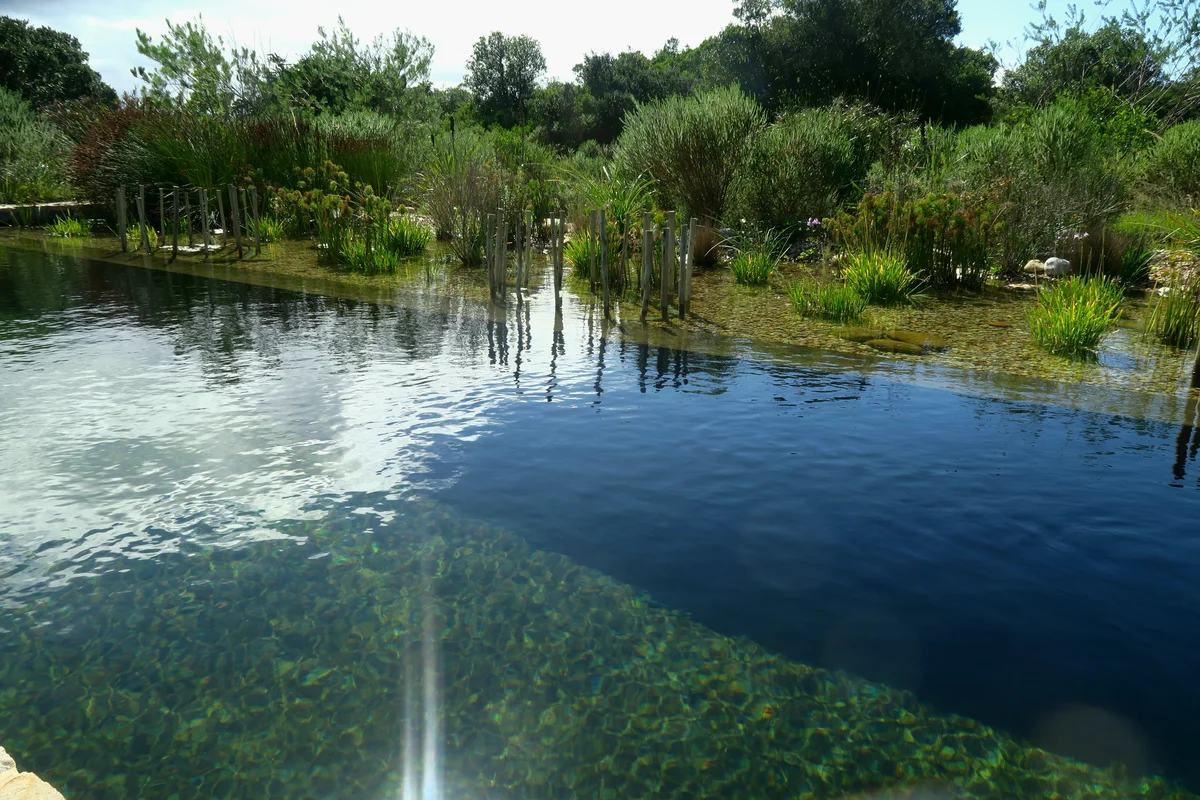
What Is a Natural Swimming Pool?
A natural swimming pool is a water body designed for swimming, in which the water is kept clean by biological processes rather than chemicals. The pool is divided into two zones:
- The swimming zone — clear, open water where you swim. Depths typically range from 1.5m to 2.5m at the deepest point.
- The regeneration zone — planted with aquatic and marginal plants, this zone filters the water biologically. Aquatic plants absorb nutrients; beneficial micro-organisms in the substrate break down organic matter. This zone must be at least 30% of the total water surface area to function correctly.
A pump circulates water from the swimming zone through the regeneration zone and back. The system is designed so that water entering the swimming zone has passed through the biological filter. The plants and micro-organisms do the work that chemicals do in a conventional pool — but without the skin irritation, the chemical smell, or the ongoing consumable costs.
Is South Africa a Good Environment for Natural Pools?
South Africa's climatic diversity means the answer depends on where you are. The best environments for natural swimming pools in South Africa share three characteristics: adequate rainfall (or the means to top up water losses), temperatures that don't regularly exceed 35°C for extended periods, and access to indigenous aquatic plant species suited to the local conditions.
The Garden Route — particularly from Knysna through to Plettenberg Bay — is among the best locations in South Africa for a natural pool. Year-round rainfall, mild temperatures, and a wide range of suitable indigenous aquatic plants make the biological system particularly robust and effective here. The Western Cape's wetter regions (Constantia, Stellenbosch, Franschhoek, Hermanus) also perform well. Inland Gauteng and the dry Karoo are less suitable without supplemental water management.
How Do Natural Pools Compare to Conventional Pools?
Initial cost: Natural pools typically cost 20–40% more to build than a conventional pool of comparable swimming area. This reflects the additional engineering, the regeneration zone construction, and the planting. However, the long-term cost comparison changes significantly when operational costs are included.
Running costs: A conventional pool in South Africa typically costs R2,000–R5,000 per month in chemicals, electricity (for high-powered filtration pumps and heating), and equipment maintenance. A natural pool running a low-energy circulation pump and requiring no chemicals typically costs R500–R1,500 per month to operate — a saving of R18,000–R42,000 per year.
Water quality: A correctly designed natural pool provides water quality comparable to a well-maintained conventional pool. The key difference is the absence of disinfection by-products: chloramines, trihalomethanes, and other chlorine breakdown compounds that are present in conventional pool water and which cause skin irritation, red eyes, and respiratory sensitivity in some swimmers.
Aesthetics: Natural pools look different to conventional pools — and that is often the point. They integrate into a garden rather than interrupting it. The planting, the natural stone or timber edging, and the shifting colour of the water create a visual richness that concrete and tile cannot replicate.
Maintenance Requirements
Natural pools require different maintenance to conventional pools, but not necessarily more. The main tasks are:
- Checking water levels and topping up as needed (similar to any pool)
- Removing excessive leaf fall or organic debris from the swimming zone (more critical in autumn)
- Annual or biannual division of aquatic plants in the regeneration zone to prevent them from becoming overcrowded
- Monitoring water clarity and adjusting plant ratios if needed (this is rarely necessary in a well-designed system)
- Occasional cleaning of the pump and skimmer basket
What natural pools do NOT require: weekly chemical testing and dosing, backwashing sand filters, managing chlorine odour, or dealing with chemical-induced equipment corrosion. The overall maintenance time is comparable to or less than a conventional pool for most owners.
Who Installs Natural Pools in South Africa?
Six Kingdoms is the only installer of certified natural swimming pools in Sub-Saharan Africa, working in partnership with EcoPools Africa — the technology behind 30+ years of natural pool engineering across Europe, the UK, and now South Africa. Our installations are built to the international standards developed by the European Natural Swimming Pool Association, adapted for South African climatic conditions and using locally-available indigenous aquatic plant species.
Our natural pool projects are concentrated on the Garden Route, but we can advise clients in other South African regions about feasibility and, in appropriate cases, extend our installation services beyond the Garden Route. Contact us to discuss your project →
Converting an Existing Pool to a Natural Pool
Converting an existing conventional pool to a natural swimming pool is possible in some circumstances. The feasibility depends on the existing pool's size, shape, location, and structural condition. Conversion typically requires creating a regeneration zone adjacent to or as an extension of the existing pool, redesigning the hydraulic system, and establishing the biological filter. Six Kingdoms can assess your existing pool and advise on conversion options. Learn more about our EcoPool approach →
Ready to Explore a Natural Pool?
Six Kingdoms installs certified EcoPools across the Garden Route. Tell us about your project and we'll outline what's possible.
Get in Touch →