Eco Pools on the Garden Route: Natural Swimming Pool Design & Installation
The Garden Route is one of South Africa's best environments for natural swimming pools. The climate is ideal — warm summers, mild winters, year-round rainfall — and the biological filtration that drives an EcoPool thrives in exactly these conditions. Six Kingdoms designs and builds natural pools from Mossel Bay to Plettenberg Bay, all in partnership with EcoPools Africa.
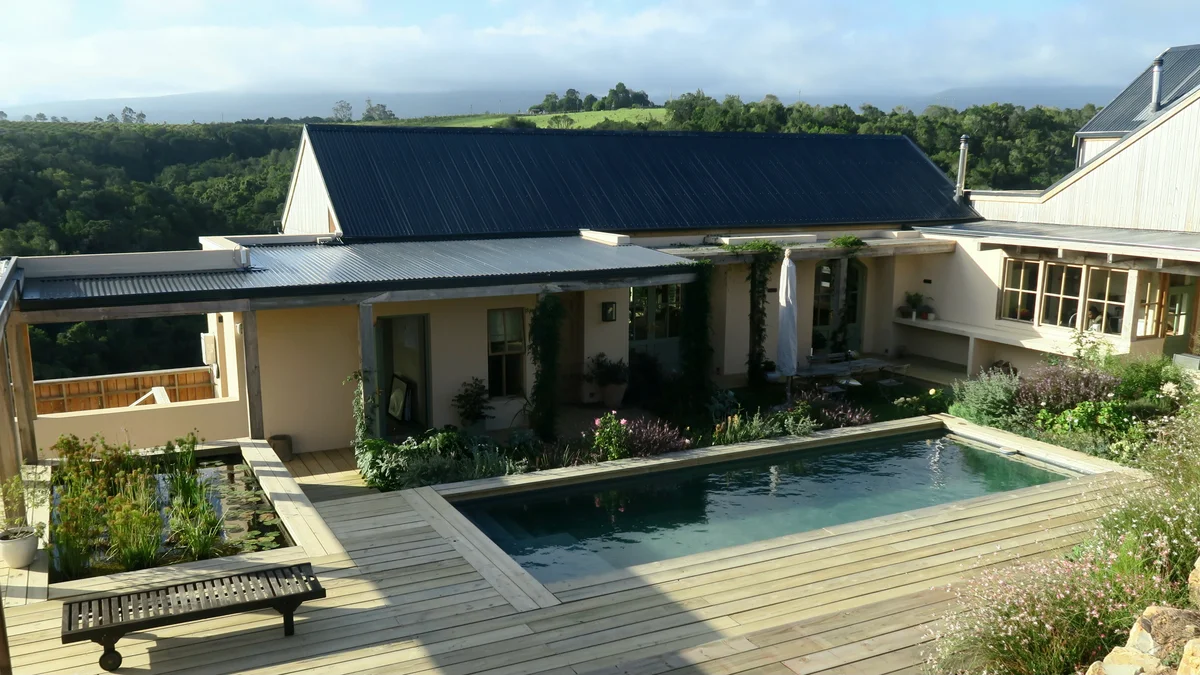
An EcoPool is not a conventional swimming pool with aquatic plants added. It is a carefully engineered system in which the water is kept clean and clear entirely by biological processes: aquatic plants absorb nutrients, beneficial micro-organisms break down organic matter, and a hydraulic design ensures that clean water reaches the swimming zone while plant-filtered water circulates through the regeneration zone. No chlorine. No stabilisers. No salt. Just living water.
Why the Garden Route is Ideal for Natural Pools
Several factors make the Garden Route one of the best places in South Africa to install a natural swimming pool:
- Year-round rainfall — water levels stay relatively stable without heavy supplementation
- Warm but not extreme temperatures — the biological filtration system operates most efficiently between 10°C and 30°C, which covers most of the Garden Route's seasonal range
- High plant growth rates — the humid coastal climate means aquatic plants establish quickly and grow vigorously, which accelerates the maturation of the biological filtration system
- Indigenous planting integration — a natural pool integrates visually with indigenous coastal and fynbos gardens in a way that conventional pools rarely achieve
- Environmental sensitivity — many Garden Route properties adjoin protected areas where chemical pool runoff would be inappropriate or restricted
Our Garden Route Projects
Six Kingdoms has installed EcoPools at properties across the Garden Route. Among our completed projects:
House Jamieson, Knysna (The Krags) — A generous natural swimming pool set into the hillside above Knysna, with sweeping views over the lagoon and the Heads. The pool features a large swimming zone with a generous deep point, a substantial regeneration zone planted with indigenous aquatic species, and a deck and surround of locally-sourced materials. The water has been consistently clear since commissioning, maintained entirely by biological filtration.
Green House, Keurboom Strand (Plettenberg Bay) — An EcoPool fully integrated into a coastal indigenous garden, with the regeneration zone designed as a visual feature in its own right. The planting palette references the coastal fynbos of the Bitou corridor, and the pool merges seamlessly with the surrounding garden.
View the full natural pool portfolio →
How EcoPools Are Built
Every natural pool installation follows a structured process:
- Site assessment — understanding the sun exposure, soil conditions, drainage, and gradient of the site
- Design brief — agreeing on the pool size, shape, depth profile, regeneration zone layout, and surround design
- Hydraulic design — engineering the flow pattern to ensure clean water circulation and biological filtration efficiency
- Construction — excavation, liner installation, technical equipment fitting, and planting
- Commissioning — establishing the biological system and monitoring water quality through the maturation period (typically 6–12 weeks)
- Handover and maintenance guidance — training the owner in the low-maintenance routines that keep the pool functioning optimally
EcoPool Questions Specific to the Garden Route
Will the pool stay clean in a high-rainfall area? Yes — rainfall itself is not a problem for an EcoPool. The pool volume is sized to handle occasional overflow. What matters is that the biological filtration system is correctly proportioned and that the hydraulic design manages water flow efficiently regardless of seasonal variation.
Can the pool be used year-round? On the Garden Route, pool temperatures are comfortable for swimming from October through to May for most people. Winter months (June–August) are cooler but swimming is still possible on warmer days.
What happens to the aquatic plants in winter? Many indigenous aquatic species are winter-active on the Garden Route. Others die back partially and regrow vigorously in spring. The biological filtration system continues to function year-round, and the winter appearance of a well-planted EcoPool can be striking — restios and sedges provide winter structure.
How large does the pool need to be? There is no minimum size, but the regeneration zone must be adequately proportioned to the swimming zone — typically at least 30% of the total water surface area. A smaller pool with a correctly proportioned regeneration zone works better than a large pool with an undersized plant zone.
Ready to Discuss Your EcoPool?
Six Kingdoms works with clients across the Garden Route on EcoPool projects from initial concept through to completion. Contact us to arrange an initial conversation →
Natural Pools for the Garden Route
Six Kingdoms installs certified EcoPools across the Garden Route in partnership with EcoPools Africa. Get in touch to start the conversation.
Enquire About an EcoPool →